




Mortgage Rates Dip to 7.11%: What It Means for Buyers and Sellers in the Bronx, Manhattan and Westchester
Mortgage rates fell for a fourth straight week, with the 30-year fixed averaging 7.11% as of November 12, the lowest in seven weeks. Here is what the dip means for buyers and sellers in the Bronx, Manhattan and Westchester, and what to do about it.
Mortgage rates just did something they have not done in a while: they fell for the fourth week in a row.
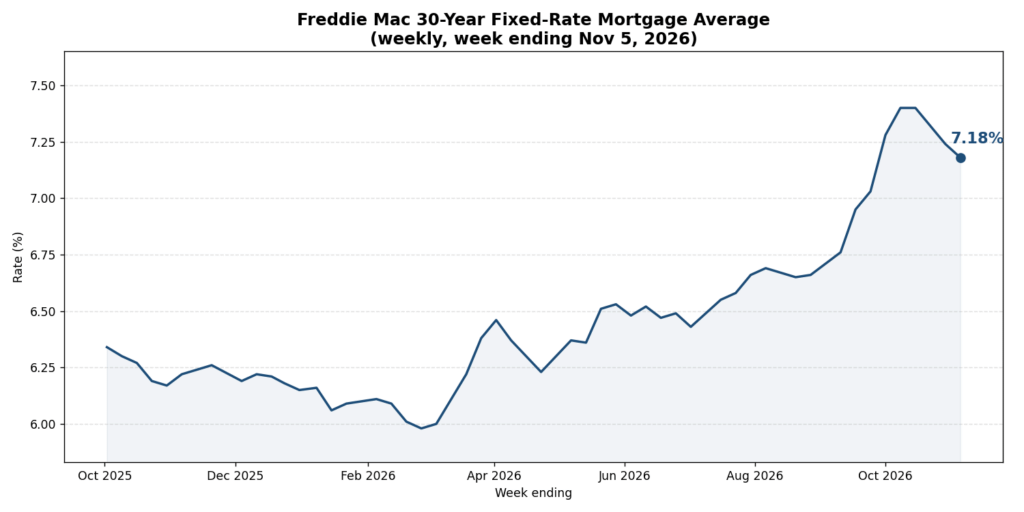
Freddie Mac’s Primary Mortgage Market Survey, released Thursday, November 12, put the average 30-year fixed-rate mortgage at 7.11%, down from 7.18% the week before. It is the lowest reading in seven weeks, and it caps a slide from the 7.40% peak we saw in mid-October. As Freddie Mac chief economist Sam Khater put it, “Mortgage rates dropped to their lowest level in seven weeks, a welcome development that gives borrowers greater flexibility as they navigate the current housing market.”
Seven basis points is not a revolution. Nobody should pretend it is. But four weeks of declines in the same direction is a trend worth paying attention to, especially if you have been sitting on the sidelines waiting for a sign. Here is where rates stand now, what the move actually means for your monthly payment, and how it plays out differently in the Bronx, Manhattan and Westchester.
One note of caution before we get into the numbers: daily rates have already ticked back up since the survey week, after a hotter than expected inflation report pushed the 10-year Treasury yield to 5.10% on November 12, up from 4.84% a week earlier. The weekly average lags daily moves, so this window of relief may be short. That does not make the trend meaningless, but it does mean buyers should treat it as an opening to act on, not a new normal to count on.
Where Mortgage Rates Stand Right Now
The latest Freddie Mac Primary Mortgage Market Survey, for the week ending November 12, 2026:
| Loan type | This week | Last week | A year ago |
|---|---|---|---|
| 30-year fixed | 7.11% | 7.18% | 6.24% |
| 15-year fixed | 6.45% | 6.57% | 5.49% |
The 30-year has now eased four weeks running: 7.40% on October 15, 7.32% on October 22, 7.24% on October 29, 7.18% on November 5, and 7.11% on November 12. That is 29 basis points off the mid-October peak. The 15-year fell even faster this week, down 12 basis points, which widened the gap between the two loans to 66 basis points.
A quick note on what these numbers are: the survey tracks conventional, conforming home purchase loans for borrowers with excellent credit who put 20% down. It is a national average, not a quote from your lender, and your actual rate will depend on your credit, your down payment, the loan size and the property type.
What it does to a monthly payment
Here is the math on a $500,000 loan, principal and interest only, before taxes, insurance and maintenance:
- At today’s 7.11%: about $3,364 a month on a 30-year fixed.
- At last week’s 7.18%: about $3,371 a month. The week’s dip saves roughly $7 a month.
- At the October peak, 7.40%: about $3,462 a month. A buyer who waited out the peak is saving about $98 a month.
- At a year ago, 6.24%: about $3,075 a month. So even after four weeks of declines, the same loan still costs about $289 more per month than it did a year ago.
On a $350,000 loan, the payment is about $2,354 a month now, versus about $2,153 a year ago. On a $400,000 loan, it is about $2,691 now, versus about $2,460 a year ago. On a $700,000 loan, it is about $4,709 now, versus about $4,305 a year ago.
The honest read: the direction is your friend, but the level is still high. A buyer who waited out the October peak is saving real money. A buyer comparing today to last fall is still paying meaningfully more. Both things are true, and your strategy should account for both.
Why Our Markets React Differently
National averages and headlines hide local realities, and the Bronx, Manhattan and Westchester do not move in lockstep. This week we have fresh local numbers to work with, and they tell an interesting story: rates are easing, but inventory, not rates, is now the binding constraint in New York City.
Manhattan is a two-speed market. A large share of Manhattan deals close in cash, especially at the top end, so rate moves barely register for those buyers. The financed buyer is a different story: in the lower and middle price bands, where mortgages do the heavy lifting, every tenth of a point changes who can bid and how high. October showed the split clearly. Manhattan’s median sale price reached $1.28 million, up 15% on the year, and buyers signed 2,926 pending sales, 5% ahead of last year. When rates ease, financed buyers come back first in those bands, and that is where we see competition pick up.
The Bronx is a financed-buyer market. Co-ops dominate Bronx sales, and co-op buyers overwhelmingly finance. That makes the Bronx more rate-sensitive than Manhattan: when rates rise, a bigger share of the buyer pool feels it at once, and when rates ease, more buyers can suddenly make the numbers work. The trade-off is that Bronx prices are lower to begin with, so the same rate move translates into a smaller dollar swing than it does in Manhattan or Westchester. And the Bronx still looks affordable next to the rest of the city. In Riverdale, the median sale price was $400,000 in October, and buying there pulls ahead of renting financially in 3.9 years, one of the shortest break-even times in the city.
Westchester is a single-family market, and it moves on monthly payment math. At Westchester prices, a $700,000 loan is typical, and the gap between today’s rate and a year ago is about $404 a month. That is real money, and it is why Westchester buyers have been so rate-focused: the decision to buy a house there is, more than anywhere else in our markets, a decision about what monthly payment you can carry.
The bigger local picture: there are not enough homes for sale. StreetEasy’s October report, published November 12, found just 17,496 homes for sale across the five boroughs, the lowest October inventory since 2017, down 3.1% from a year ago. Homes entering contract fell 7.9% from last year, to 1,904, and the citywide median sale price was $900,000. Yet homes that did go into contract moved fast, a median of 48 days on market, the fastest since May 2022, and 21% sold above asking, up from 18.9% a year ago. Nationally, the picture is similar: October existing-home sales fell 5.5% to a 3.75 million annual pace, the lowest since August 2010, while Redfin reported the first year-over-year decline in the national median sale price in three years, down 0.4% to $388,634, even as the New York City area median rose 4.4%. Put together, it means easing rates are meeting a market with very little to buy. Well-priced homes in our markets are still moving quickly, and that is unlikely to change while inventory stays this thin.
What It Means for Buyers
Rates easing is good news, but it is not a reason to throw your plan out the window. Here is how we would play it:
- Get a fully underwritten pre-approval, not a quick pre-qualification. In a market where financed buyers are coming back and inventory is thin, sellers and their agents look hard at how solid your financing is. A fully underwritten approval, where the lender has already verified income, assets and credit, puts you ahead of buyers holding a letter that took ten minutes to generate.
- Ask your lender about ARM options. A 7/1 or 10/1 adjustable-rate mortgage prices below the 30-year fixed right now, and if you expect to move, refinance or pay the loan down within that window, the savings could make a difference. Just make sure you understand the adjustment, and that you could carry the loan if rates are higher when it resets. Talk to your lender with questions.
- Price a rate buydown before you dismiss it. A temporary buydown, where the seller or developer pays to lower your rate for the first year or two, can be cheaper for a seller than a price cut and better for you than a lower price at a higher rate. Run the numbers with your lender both ways before you negotiate.
- Think carefully about your rate lock length. A 30-day lock is standard, but co-op purchases in the Bronx can take 60 to 90 days from contract to closing, and board approval is outside your control. A longer lock costs more, but it protects you if rates bounce while you are waiting on a board. That matters more than usual right now, with daily rates already ticking up after the inflation report. This is why it’s important to work with a lender who is experienced with co-op sales. Ask your lender what each option costs and decide with eyes open.
- Co-op boards look at your full financial picture: post-closing liquidity, debt-to-income, and reserves. A lower rate helps your monthly payment, but the board still wants to see cash left over after closing. Keep your reserves intact and do not stretch your down payment to the last dollar.
- Buy what you can carry today. The best use of a rate dip is not to stretch to a bigger price. It is to buy the home you can comfortably carry at today’s rate, knowing a refinance is a possibility later, not a plan. If rates fall further, you can refinance. If they do not, you are still fine, because you bought within your means.
What It Means for Sellers
For sellers, a rate dip is a tailwind, not a starting gun.
Price for the actual buyer pool.
Lower rates bring financed buyers back into the market, which is great news if your home is priced where those buyers live. It does not mean you can price above the market and expect the rate news to bail you out. Buyers who can suddenly afford your home are still comparing it to everything else at that price, and with inventory this low, a well-priced home stands out fast.
Judge financing strength, not just price.
When multiple offers come in, look past the top number. A slightly lower offer with a fully underwritten approval, a strong down payment and clean contingencies can be the safer deal than a top bid that falls apart in underwriting or at the board. Ask your agent to walk you through the financing behind every offer.
Expect contingencies to stay in play.
Even with rates easing, buyers are careful, and financing and appraisal contingencies are still normal in our markets. A clean offer is worth something, but do not assume every buyer will waive everything just because rates ticked down.
Ask about a CEMA where it applies.
In New York, a Consolidation, Extension and Modification Agreement can save a buyer significant mortgage recording tax on a refinance or on certain purchases, and that savings can make your home more attractive to a financed buyer. It is not relevant to every deal, and it needs a lender and attorney who know how to do it, but it is worth asking about when the numbers are close.
Co-ops vs. Condos: How Financing Plays Out
This is the part of New York real estate that surprises buyers from everywhere else, and rates hit the two property types differently.
Co-ops are the Bronx’s bread and butter. You are buying shares in a corporation, not real property, and the board approves or denies your sale. Boards typically want 20% down or more, strong post-closing reserves, and a debt-to-income ratio they are comfortable with, often around 28% for housing costs. One quiet advantage: because a co-op share loan is not a mortgage on real property, co-op buyers generally do not pay New York’s mortgage recording tax on their loan. On a large loan, that is a meaningful saving.
Condos give you real property, no board approval of your finances (though buildings have their own rules), and typically more flexibility on down payment and subletting. The trade-off is that condo buyers do pay mortgage recording tax, which in New York City runs about 1.8% to 1.925% of the loan amount on most residential loans, plus a $30 recording fee. On a $500,000 loan, that is roughly $9,000 to $9,600. A rate dip does not change that tax, but a buydown or a CEMA conversation can change the total cost picture, so it is worth pricing the whole deal, tax included, before you choose between a co-op and a condo.
Frequently Asked Questions
Are rates above or below 7% right now?
Above. The 30-year fixed averaged 7.11% in Freddie Mac’s survey for the week ending November 12, 2026, and the 15-year fixed averaged 6.45%. Rates have fallen four weeks in a row, but they are still about a full point above where they were a year ago.
Should I wait for rates to fall further?
That depends on what waiting costs you. If you find the right home at a price you can carry today, waiting for a better rate is a gamble: rates could fall, or they could bounce back to October’s levels, and the home you want could sell in the meantime. Daily rates have already ticked up since the survey week, which is a reminder that weekly averages can move fast. If you are not finding the right home, or the payment does not work at today’s rates, waiting is perfectly reasonable. The question is not what rates will do. It is whether the home and the payment work for you right now.
Do lower rates mean lower prices?
Usually the opposite, at least in the short term. Lower rates bring more buyers into the market, and more buyers competing for the same homes tends to support prices, not cut them. In New York City right now, that effect is amplified by inventory: with the fewest October listings since 2017, well-priced homes are still moving in a median of 48 days. What lower rates really do is change who can buy and how much home they can afford, which is why well-priced homes in our markets tend to move faster when rates ease.
Is it a good time to sell?
If your home is priced for the buyer pool that exists today, yes. Easing rates are bringing financed buyers back, and that is the pool most Bronx and Westchester sellers depend on. What has not changed is the basics: price it right, present it well, and judge offers on financing strength as well as price. A rate dip helps a good listing sell faster. It does not rescue a bad price.
Talk Through Your Next Move With Us
Four weeks of declines is a real shift, and it changes the math for buyers and sellers across the Bronx, Manhattan and Westchester. But the right move is still personal: it depends on your budget, your timeline, and the home you actually want.
If you are thinking about buying or selling, let’s talk it through together. We will run your numbers at today’s rates, look at what is actually available in your price range, and help you decide whether this is your moment or whether waiting is the smarter play. Reach out to us here and we will take it from there.
Sources
- Freddie Mac, “Mortgage Rates Decline for Fourth Consecutive Week to 7.11%,” Primary Mortgage Market Survey, November 12, 2026: https://www.freddiemac.com/pmms
- Freddie Mac press release, November 12, 2026: https://www.globenewswire.com/news-release/2026/11/12/3402013/0/en/mortgage-rates-decline-for-fourth-consecutive-week-to-7-11.html
- StreetEasy, “Inventory, not mortgage rates, weighing on NYC sales,” October 2026 NYC housing market report, November 12, 2026: https://streeteasy.com/blog/inventory-not-mortgage-rates-weighing-on-nyc-sales/
- Redfin, “October Marks the First Month in 3 Years With a Decline in U.S. Home-Sale Prices,” November 10, 2026: https://www.redfin.com/news/home-prices-decline-october-2026
- National Association of Realtors, October 2026 existing-home sales, reported November 12, 2026: https://wrenews.com/freddie-mac-mortgage-rates-november-12-2026-7-11-percent/



