



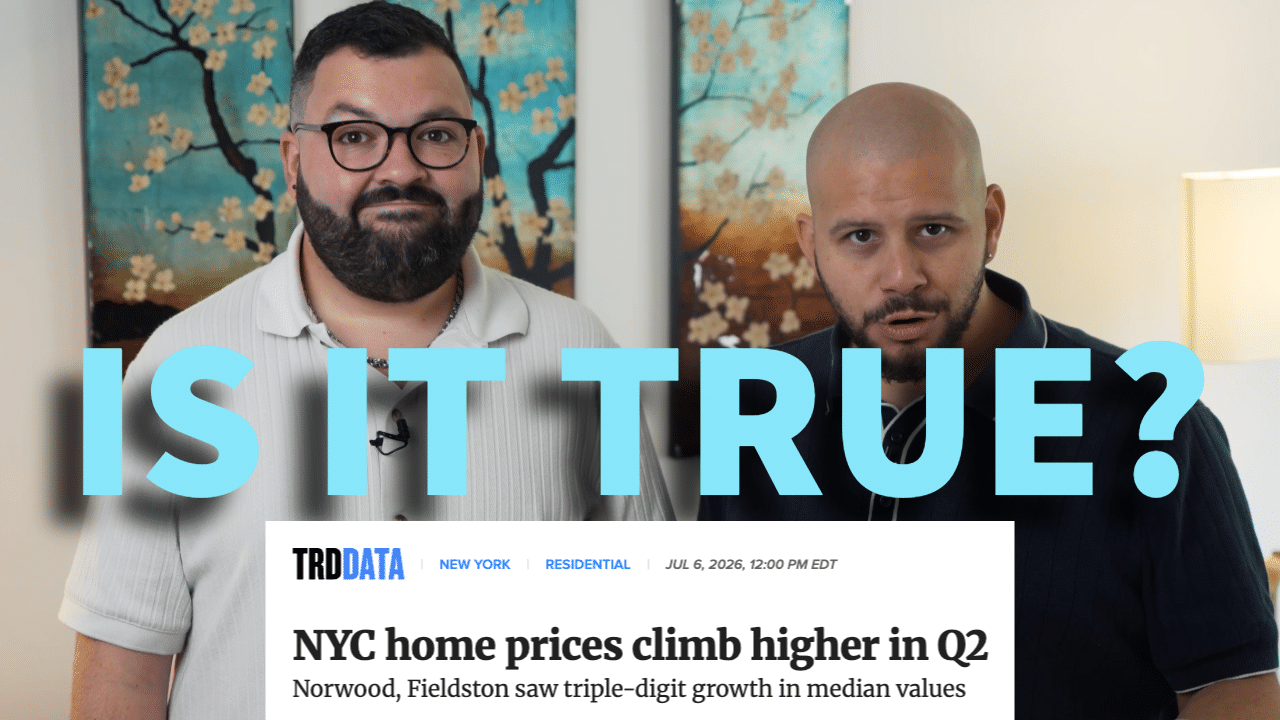
Did the Bronx Really Increase in Value by 400%?
Headlines said Fieldston home values skyrocketed 400% in a single year. They didn’t. In our newest video, we break down how one $6.5M “unicorn” sale skewed the numbers in a 250-home enclave, why Zillow estimates can’t be trusted in micro-markets, and the one question that actually tells you what your home is worth.
So, did property values in the Bronx really increase by over 400% in a single year? If you read the headlines last month, you’d think a group of homeowners up in Fieldston and Norwood just won the lottery. Zillow estimates shot up, algorithms broke, and suddenly a whole lot of sellers thought their house was worth quadruple what they paid for it.
We even got a call from The Real Deal. They wanted to interview us about why the Fieldston market had exploded. We told them the truth that no algorithm can admit: it didn’t.
In our newest video, we break down exactly how real estate data can lie to you, why relying on Zillow for a home valuation is a massive mistake, and the one metric that actually matters if you want to know what your home is worth.
The 400% myth was born from the law of small numbers
Fieldston isn’t like the parts of Manhattan where hundreds of co-ops change hands every month. It is a heavily landmarked enclave in Riverdale with only about 250 homes, and turnover is incredibly low. Families buy here for schools like Horace Mann, Riverdale Country, and the Fieldston School, and many stay for over 30 years.
With so few transactions, the data gets volatile. In 2025, around 15 homes sold in all of Fieldston, most of them between $1 million and $2 million. But among those 15 was one monster sale: a gorgeous mansion for about $6.5 million. That single “unicorn” sale dragged the average price way up, the algorithm saw the average jump, and the press ran with the headline: Fieldston values skyrocket 400%.
The data was technically accurate. Practically, it was a complete lie. No 1920s Dutch colonial quadrupled in value. A huge sale a decade in the making finally found its buyer.
Why this data trap is dangerous for sellers
Say you own a beautiful four-bedroom in Fieldston. You see the headline, you check Zillow, you see the big green arrow pointing up, and you tell your agent you want a million dollars more than your neighbor got last year.
But buyers aren’t algorithms. They can see whether your home has the private tennis court, the indoor pool, and all the other amenities of the $6 million estate that skewed the numbers. No buyer is going to pay a 400% premium for your house.
So you overprice it. It sits. It gets stale. And 90 days later, you’re forced into a massive, embarrassing price cut, chasing the market down. We see it all the time: sellers reset their expectations based on a headline and underestimate what the comparables actually say.
Why it is dangerous for buyers, too
Buyers have the opposite problem. They see the 400% headline and assume the neighborhood is hot and rapidly appreciating, when it may not be, and they base real decisions on that assumption.
The one question that tells you what a home is worth
Zip code averages, price-per-square-foot aggregates, and monthly trend reports are far less useful in micro-markets like Fieldston. You can’t compare a mid-century modern to a 1920s brick Dutch colonial just because they’re on the same block. Is the house basically on the highway? Does it need a massive retaining wall? What is the actual property tax bill? How much will it cost to renovate a historic home? An algorithm can’t see any of that.
The one question that matters: what did a buyer pay for a house with a similar layout and condition within a half mile in the last six months, and how long did it take to sell? Everything else is noise.
Bad data creates bad decisions. The sellers who regret their listing price and the buyers who regret overpaying almost always relied on an internet average instead of a trusted adviser who knows the market on the ground.
Don’t let a viral headline set your strategy. If you’re looking to buy or sell in Fieldston, Riverdale, or anywhere in New York City, work with a broker who can sift through the data and get to the truth of what your home is worth. That’s what we do for every client.
Reach out to us today if you want help making sense of this market. And don’t believe everything you read.



